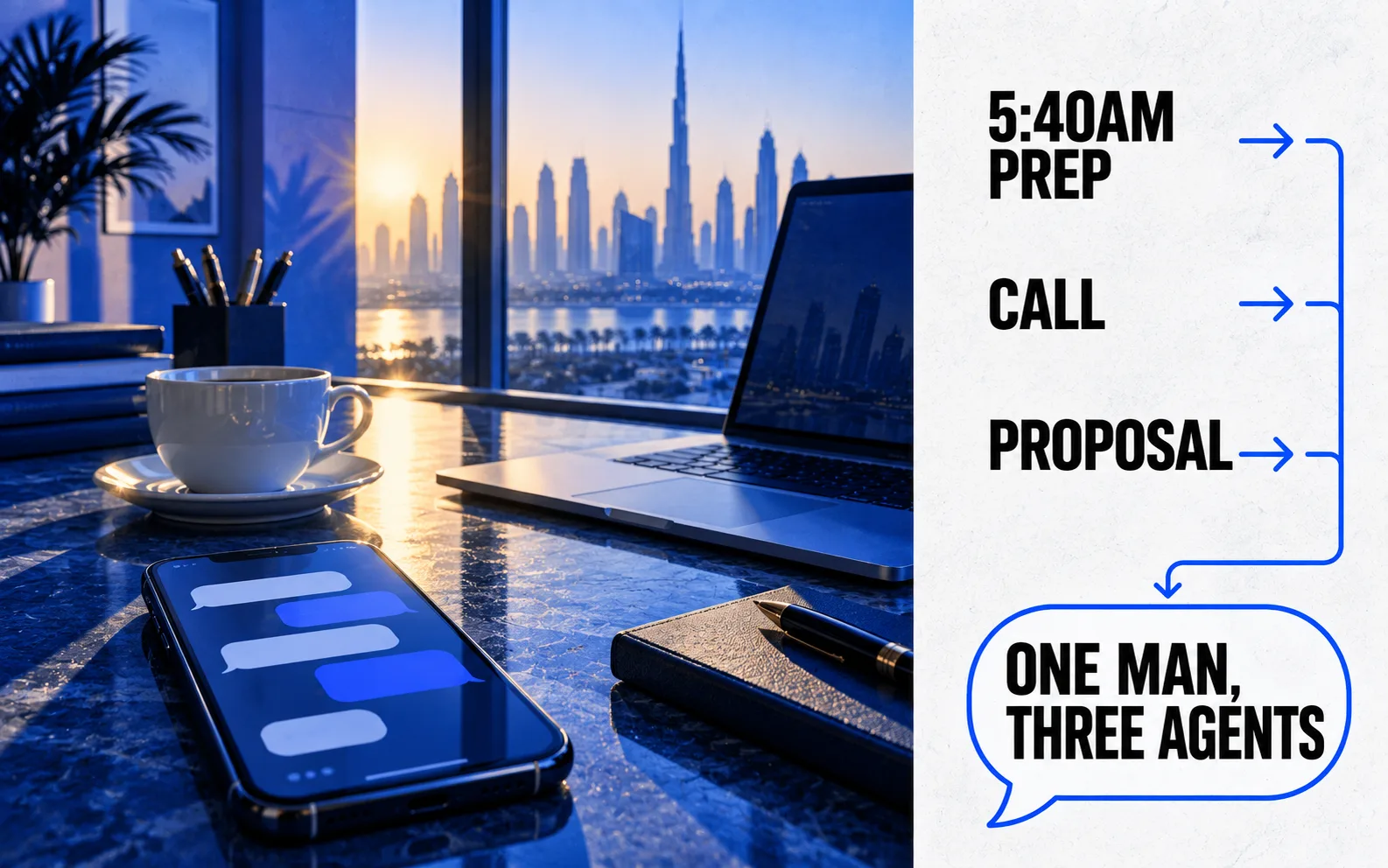
I run my agency with three AI agents. The agents live in the cloud and never log off. One keeps the whole picture, one runs engineering, one runs the business side. I talk to them from my phone, my laptop, wherever I am.
Here's an actual day: Tuesday 29 September, the night that followed and the Wednesday morning after it, reconstructed from the records the system keeps on itself. Every time below comes from a log. Count what comes out of it and it's an agency's worth of output, from one person and three agents.
5:40am. The prep was already written
My business agent had written me a prep file for an early call with a new client, an e-commerce company that sells across a handful of marketplaces. I read it before we started, so I walked in prepared.
Then the tool transcribing the call stopped halfway through. My agent was on the call recording the whole thing, so nothing was lost.
I opened a thread with my engineering agent, gave it the recording, and asked for the important parts.
This is the first thing people don't expect about running a business this way. The agent didn't start from nothing. It already had the project page, the client's history, the earlier notes and the rules of how we work. I gave it one sentence and a recording, and it knew where to look.
5:49am. Learning a business in an hour
Before I could design anything for this client, I had to understand how her money actually moves.
So I asked: explain her business mechanics and her accounting risks in plain language.
The answer came back as a full report. She sells three ways: cash, credit, and stock that a shop holds and pays for only once it sells. Some marketplaces hold the stock themselves, some leave it with her. Every sale has to land in her inventory and accounting software exactly once, and the money has to reconcile with what each marketplace pays out. Then the tax side, in plain words.
That took under an hour, and it meant my next question was the right one.
6:40am. Every possible route, checked live
My next request was bigger: map every realistic way to connect each of her sales channels to her inventory system, without a ready-made connector, and check the off-the-shelf options against their live documentation.
Then I asked something simple that changed the whole plan. Why does nobody on her team trust the stock number in the system, if everything's supposed to be connected? Why is there a person counting by hand?
That question is the job. The software was connected. Nobody could see whether a sale had actually been recorded, so a human double-checked everything. So the fix was proof: a way for everyone to see that each sale landed once.
9:44am. The premise flip
By mid-morning we had a whole set of approaches. I asked whether an off-the-shelf integration tool would beat our method.
The answer flipped my assumption around. That kind of tool is built to let software companies offer integrations to their own customers. It isn't built for one business connecting its own shops. Our way was better for her.
Then the agent suggested a new angle for one of her marketplaces. I was genuinely excited. It took my own stepping back to another level.
10:39am. "Did we actually land on one?"
That was my exact question, five hours in. By then we'd learned her business, checked every route against live documentation and flipped the plan's main assumption.
We landed on three versions, and only two went to the client. The third was a later upgrade, so we didn't pitch it. The running costs are hers in every version; our fee is ours.
Then the agreement. I wanted the wording to say we aim to deliver, not that we guarantee it, because the client pays for the audit and the build, and I'm not doing free work to find out something can't be built. The agent made the change and told me "aim to" on its own wasn't enough protection. What actually protects you is where the money sits at each stage. It rewrote the payment structure around that.
The proposal was marked final, the agreement marked ready to send, and both were filed on the client's page.
The rest of the morning, in parallel
While all of that was happening, other work was running:
- Two welcome films, one in English for this client and one in Gulf Arabic for another client. I rejected the first take. The second take, rebuilt with proper animation, I loved.
- A small status app for the client's shop, read-only, so she can see where things stand. Five versions to get it right, then published.
- The agreement and payment link went to the client.
5:18pm. Six files from one message
In the afternoon I wanted to see the system design as pictures. I asked for the canvases so I could drag them into three different whiteboard tools and compare.
Three canvases came back, each in two formats. Six files, all opening cleanly.
6:47pm. "Finally"
That's what I typed, three times.
The system design was done, and I had a piece of it ready that I was going to "discover" for the client after the first week, even though I'd already worked it out. My engineering agent wired the operational side underneath it: how an order gets noticed, checked and recorded once, how the new stock number reaches her other shops, and how we prove it changed.
7:15pm. RalvetoOS, same day
In the evening I switched to my own product. RalvetoOS is the system I'm building so that anyone, and any business, can own an AI setup like this one.
I sent a screenshot of something I wanted it to remember, and told the agent not to keep it in its head: write it down.
Then I asked it to set up a scheduled job that watches the products and ideas around RalvetoOS and logs anything relevant. It was live within the hour, running four times a day, filing what it finds into the library where my agents can pull from it later.
Earlier that day a design pass had produced four clickable prototypes of RalvetoOS. The last one was a working workspace.
8:03pm. The system reviews itself
This is the part I care about most.
At the end of the client work, my engineering agent started a fresh copy of itself with one job: review the whole client thread end to end and find every mistake it, my business agent and the other models had made.
Two reviews ran. Twelve new lessons came out of them, and three existing ones were reinforced, because they'd happened again. Each lesson went into a queue to be reviewed and filed into the skills that agents load before doing that kind of work again.
Every mistake gets written down with a source, and the next agent to do that job reads it first.
9:59pm. The line the agents don't cross
The agreement had to go out through an e-signature service. My business agent tried to prepare it and got it wrong, so it handed the job to my engineering agent with everything it had learned.
The engineering agent drove the coding assistant on my laptop to prepare one envelope. Prepared, not sent. I press send.
Agents prepare. I decide what leaves.
1:04am. Cleaning up the day
I'd been working with other AI tools on my laptop all day too, separate from my agents. I asked my engineering agent to go through every one of those conversations from the last two days, reconcile them with everything else, and log what mattered.
It went through them, filed what was missing, and turned two of the methods into skills my agents can now use: how to make a client welcome film, and how to run a design prototype pass.
At 2:30am I asked it to clean up my laptop's desktop until I could see nothing except one folder. It went through everything, moved it, and wrote a list of where each thing went.
4:43am. Ideas from my phone
I don't stop when I close the laptop.
From my phone I sent a thought about RalvetoOS: a way to pull together everything about a person, not only from their own head. My coordinating agent filed it as an idea, with its own pushback attached.
At 4:58am I asked whether a client could sign in to our app with the AI assistant his company already pays for. The agent researched it and came back: yes, it's possible and it's allowed. There's no one-click button for it. He signs in with his work account and his company's IT admin approves our app once.
At 5:07am I sent a short video I'd found and told it to learn from it and only log it if it was useful. It watched it, transcribed it, checked the four models it mentioned, and told me what was worth keeping.
Wednesday, 6:03am. The client portal
The next morning, my business agent handed engineering the job of building the client's portal end to end and putting it live on its own address.
I reviewed it mid-build. My exact words: "Mobile is perfect. Desktop has wordiness, pill spam, subtext spam." The next run took screenshots before touching anything, cut the clutter, and shipped.
By 9am it was live, and every screen had been checked on a phone and a laptop.
That evening the client signed the agreement. Before her kickoff call, my coordinating agent asked engineering for one last check. The verdict: the portal is ready. Her screens work on phone and laptop, there's no test data left in it, and she hasn't signed in yet.
I spotted one change I wanted and approved it by message. It was made, tested and pushed the same night.
While I slept
Overnight, the agents kept going. Account research for the client, checked against each vendor's own documentation. A website build on my laptop for my own brand. And the lesson queue: on 1 October, 89 waiting lessons were merged into the agents' skills, and the backlog hit zero.
One day, counted
From one Tuesday and the night after it:
- A new client's business learned, and every way to connect her sales channels checked against live documentation
- Three solution versions, a final proposal and an agreement ready to sign
- Two welcome films, one in English and one in Gulf Arabic
- A status app for her shop, published
- Four clickable prototypes of RalvetoOS
- Six system-design canvases, and the operational design wired underneath them
- A research job watching the RalvetoOS market four times a day
- Twelve new lessons from the system reviewing its own work
- The e-signature envelope prepared for me to send
- Two days of laptop conversations reconciled, and two methods turned into new skills
- An idea filed, a sign-in question researched and a video learned from, all from my phone before 5:10am
By 9am the next morning, the client's portal was live too.
That's an agency's worth of output in one day.
What this actually is
This was day six of the system running for real. It took five weeks to build and it has been running for eight days.
In that time it has carried three clients: a personal assistant agent that went live on a client's WhatsApp, the e-commerce client in this story, and a company-wide engagement for another business. Alongside them: proposals and agreements, welcome films, a status app and a client portal, my own websites and infrastructure, RalvetoOS and Harsift.
None of it needs me at a desk. Most of it I did from my phone.
Plenty of people get AI to do work. The part I care about is that every one of these moments left something behind: a lesson, a skill, a record with a source. Tomorrow's agent starts from where today's left off.
That's what HarsOS is. And it's what I'm building RalvetoOS to give everyone else.